
- Diffuser Combo UAE Deals
- Scents
- Floral (Rose, Jasmine)
- ADDRESS Aroma Oil Diffuser 500ML
- PASSION Aroma Oil Diffuser 500ML
- HARMONY Aroma Oil Diffuser 500ML
- LUXURY Aroma Oil Diffuser 500ML
- MOTION Aroma Oil Diffuser 500ML
- SOSPHERA Aroma Oil Diffuser 500ML
- SENSE Aroma Oil Diffuser 500ML
- G BLOOM Aroma Oil Diffuser 500ML
- LEGENDARY Aroma Oil Diffuser 500ML
- FOR HER Aroma Oil Diffuser 500ML
- No 3 Aroma Oil Diffuser 500ML
- PINK Aroma Oil Diffuser 500ML
- Fresh (Citrus, Aquatic)
- Woody / Oriental / Spicy (Oud, Vanilla, Amber, Sandalwood)
- ROYAL WOOD Aroma Oil Diffuser 500ML
- BROWN ORCHID Aroma Oil Diffuser 500ML
- BAKHOUR Aroma Oil Diffuser 500ML
- AMBER LEATHER Aroma Oil Diffuser 500ML
- UNIQUE WOOD Aroma Oil Diffuser 500ML
- ELITE WOOD Aroma Oil Diffuser 500ML
- MARRAKECH Aroma Oil Diffuser 500ML
- Patchouli Aroma Oil Diffuser 500ML
- COTTON CLOUD Aroma Oil Diffuser 500ML
- CHRISTMAS Aroma Oil Diffuser 500ML
- GABRIEL Aroma Oil Diffuser 500ML
- CINNAMON TONKA Aroma Oil Diffuser 500ML
- COFFEE BEANS Aroma Oil Diffuser 500ML
- Aromatic (Fougere) – Lavender, Sage, Rosemary
- Fruity (Berry, Peach)
- Floral (Rose, Jasmine)
Scent Blog
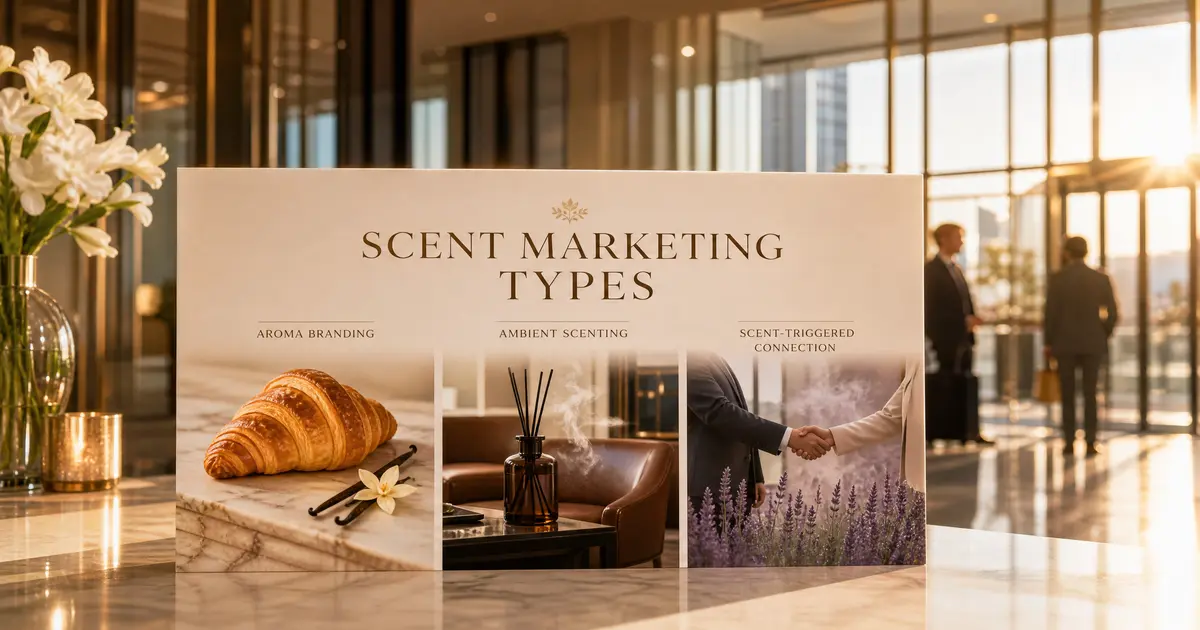
Beyond the Bakhoor: Navigating the 5 Scent Marketing Types Redefining UAE Brand Experiences
Walk into the lobby of any premier hotel in Downtown Dubai, a luxury boutique in The Dubai Mall, or a private bank in Abu Dhabi, and you will notice a specific sensory shift. It is not accidental. In a commercial ecosystem saturated with visual noise, the United Arab Emirates has emerged as the world’s most fragrance-sophisticated market. Scent, in this region, is not merely an olfactory afterthought it is a cultural dialect of hospitality, status, and memory.
While global markets often treat ambient scenting as a modern innovation requiring consumer education, the UAE enters the conversation with a distinct advantage: a multi-generational fluency in fragrance. The question for decision-makers is no longer whether to scent a commercial space, but how to select the right scent marketing type for a brand’s specific commercial goals .
The Strategic Framework: Five Core Scent Marketing Types
In professional practice, scent marketing is segmented into five distinct typologies based on the strategic outcome required. Recognizing the difference between them determines whether a scent campaign merely smells pleasant or actively drives commercial return.
1. Brand Identity Scenting (Signature Scents)
This is the most advanced category. It involves developing a proprietary, trademarked fragrance that encapsulates a brand's essence across every physical touchpoint. A Signature Scent is not selected from a catalog; it is engineered from the ground up in collaboration with perfumers to embody specific brand values sophistication, adventure, tranquility and is legally defensible as intellectual property. In the premium and ultra-luxury sectors of the UAE, where the market for luxury fragrances dominates with a market share exceeding 80%, a signature scent is a marker of exclusivity .
2. Ambient Scenting (Space Definition)
Ambient scenting targets a specific spatial atmosphere. It may not be a unique proprietary formula but is chosen to trigger a precise emotional or behavioral response. A hotel lobby might demand "dark, resinous, and complex" oud profiles to signal traditional Arabian luxury, while a contemporary medical spa might opt for "white oud" a clean, modern, and understated variant that aligns with a wellness-focused med-spa environment . This is the most common entry point for retail and hospitality environments.
3. Thematic Scenting (Narrative Marketing)
Thematic scenting supports short-to-medium-term campaigns, seasonal events, or product launches. The goal is narrative coherence. When a local manufacturer launched a 'Mocktail Collection' aimed at capturing a poolside aesthetic, the matching ambient scent was not about brand identity but about creating a momentary, thematic immersion that drives social media shareability .
4. Product-Specific Aroma (Olfactory Call-to-Action)
This highly localized technique draws the consumer toward a specific product. In a bakery-café, it might be the amplified scent of fresh bread. In a perfume hall, it involves the precise diffusion of a new launch. In the UAE's broader fragrance industry, where modern home fragrances are turning scent into a "space experience," brands use this to de-risk purchase decisions if the room smells like the luxury candle, the conversion probability increases dramatically .
5. Olfactory Brand Rehabilitation
When a brand renovates physical spaces or changes visual identity, consumers can feel disoriented. Changing the ambient scent simultaneously with visual updates accelerates the psychological acceptance of a new brand image. For a high-end Dubai retailer rebranding from a traditional aesthetic to a modern one, the olfactory transition is the silent ambassador of change.
Cultural Capital: The UAE’s Inherent Advantage
To implement these types effectively in the Emirates, one must understand the cultural substrate. Gulf fragrance culture provides a commercial advantage that cannot be replicated in Western markets. Practices rooted in Emirati hospitality, the burning of bakhoor (scented wood chips) and oud have conditioned the local consumer's olfactory palate to highly complex, resinous, and warm notes .
This means the UAE consumer does not need to be educated on why space smells matter; a subpar or synthetic scent can signal a lack of quality and negatively impact brand perception. The baseline expectation is higher. For commercial operators, leveraging cultural archetypes like mild oriental notes for a welcoming F&B setting or an "oud and rose" combination for celebratory events aligns the brand with deeply ingrained regional codes of generosity and quality .
Climate and Chemistry: The Technical Layer
The UAE’s climate adds a layer of complexity to scent marketing. High temperatures and humidity accelerate the evaporation of alcohol-based fragrances. This is why the Middle Eastern personal fragrance market has historically been anchored in oil-based perfumes, which offer superior longevity by interacting directly with the skin's warmth rather than evaporating on contact .
In ambient scenting, similar technical rigor applies. Diffusion systems must be calibrated for large, air-conditioned volumes where HVAC systems can dissipate scent unevenly. A "set and forget" approach fails. The effective strategy requires HVAC-integrated cold-air diffusion technology that breaks fragrance oils into dry micro-particles, maintaining a consistent intensity whether the space is a cool mall boutique or a hotel lobby with open doors.
Navigating the Generational Shift: Gourmand and the Viral Factor
A significant shift is reshaping the UAE’s fragrance landscape: the rise of gourmand notes. Where buyers once gravitated exclusively toward traditional ouds and florals, a younger demographic now seeks out bubble gum, chocolate, and cheesecake accords .
For scent marketing practitioners, this creates a dichotomy. A traditional Arabian luxury brand targeting high-net-worth individuals cannot simply adopt a "Cotton Candy Musk" ambient scent without eroding its brand pillars. However, a lifestyle retail brand or an F&B concept might find these contemporary, edible fragrance notes highly effective. The success of the "Arabiyat Sugar" line by a UAE-based company, anticipated to sell five million bottles, demonstrates that novelty and approachability are powerful commercial levers when strategically applied .
The Measurement Framework: Data-Driven Scenting
A modern scent marketing strategy must close the measurement loop. Implementation without data is decoration. Key performance metrics include:
Dwell Time: How long do customers stay in a scented zone versus an unscented one?
Conversion Correlation: Are specific scent profiles linked to higher basket sizes?
Recall & Sentiment: Post-exposure surveys measuring mood, service perception, and brand recall.
A published study states, One recent campaign outside the hospitality sector demonstrated a jump in purchase intent to 41% among consumers exposed to coordinated sensory advertising validating the commercial impact of integrated multi-sensory strategies . To operate in the UAE’s scent marketing arena is to operate at the intersection of centuries-old heritage and cutting-edge consumer behavior. The brands that succeed will be those that move beyond choosing a "nice smell" and instead select a specific scent marketing type with surgical intent whether it is a signature scent that protects brand identity or a thematic campaign that captures a seasonal moment. In a market where the consumer's sense of smell is as discerning as their expectation for luxury, the invisible architecture of scent often speaks louder than visual design.