
- Diffuser Combo UAE Deals
- Scents
- Floral (Rose, Jasmine)
- ADDRESS Aroma Oil Diffuser 500ML
- PASSION Aroma Oil Diffuser 500ML
- HARMONY Aroma Oil Diffuser 500ML
- LUXURY Aroma Oil Diffuser 500ML
- MOTION Aroma Oil Diffuser 500ML
- SOSPHERA Aroma Oil Diffuser 500ML
- SENSE Aroma Oil Diffuser 500ML
- G BLOOM Aroma Oil Diffuser 500ML
- LEGENDARY Aroma Oil Diffuser 500ML
- FOR HER Aroma Oil Diffuser 500ML
- No 3 Aroma Oil Diffuser 500ML
- PINK Aroma Oil Diffuser 500ML
- Fresh (Citrus, Aquatic)
- Woody / Oriental / Spicy (Oud, Vanilla, Amber, Sandalwood)
- ROYAL WOOD Aroma Oil Diffuser 500ML
- BROWN ORCHID Aroma Oil Diffuser 500ML
- BAKHOUR Aroma Oil Diffuser 500ML
- AMBER LEATHER Aroma Oil Diffuser 500ML
- UNIQUE WOOD Aroma Oil Diffuser 500ML
- ELITE WOOD Aroma Oil Diffuser 500ML
- MARRAKECH Aroma Oil Diffuser 500ML
- Patchouli Aroma Oil Diffuser 500ML
- COTTON CLOUD Aroma Oil Diffuser 500ML
- CHRISTMAS Aroma Oil Diffuser 500ML
- GABRIEL Aroma Oil Diffuser 500ML
- CINNAMON TONKA Aroma Oil Diffuser 500ML
- COFFEE BEANS Aroma Oil Diffuser 500ML
- Aromatic (Fougere) – Lavender, Sage, Rosemary
- Fruity (Berry, Peach)
- Floral (Rose, Jasmine)
Scent Blog
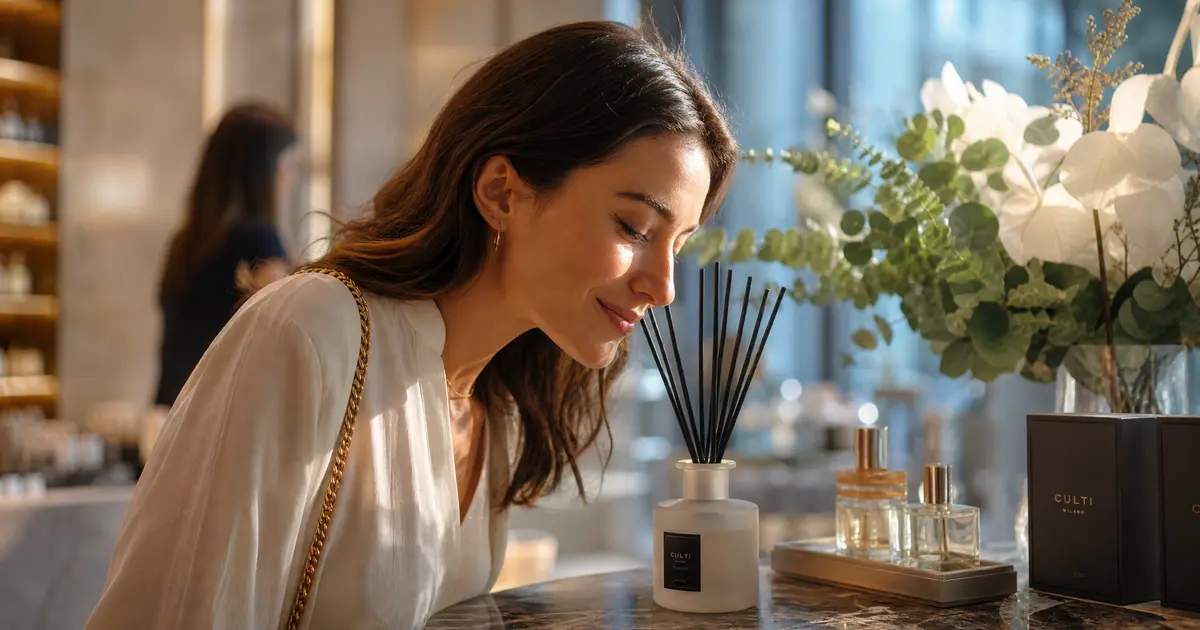
Crafting Olfactory Identity: The Rise of Retail Scent Marketing in the UAE
In the bustling corridors of The Dubai Mall or the heritage-lined pathways of Sharjah’s Al Shaba, a silent but powerful transaction occurs the moment a customer steps through a doorway. It is not visual, nor is it auditory. Before the eye catches the gleam of a chandelier or the cut of a garment, the limbic system has already made a judgment. In this split second, retail scent marketing has either opened a door to loyalty or closed it on a sale.
Speaking to brand managers across the Emirates in early 2026, a recurring theme surfaces: the region’s crowded luxury and perfume sectors are facing a sensory fatigue. With the UAE’s perfume and fragrances market valued at a formidable USD 3.39 billion in 2025 and projected to climb to USD 5.81 billion by 2034, the sheer density of choice is forcing retailers to look beyond visual branding . We are no longer merely selling products; we are curating a memory. In my years consulting for local perfume houses, I have watched scent move from a product category into a spatial strategy a tool now as critical as lighting or layout.
The Science of the Sale: Why Scent Marketing is No Longer a Luxury Add-On
The term ‘experiential retail’ is thrown around with reckless abandon in boardrooms, but in practice, it requires a neurological anchor. Scent holds the strongest tether to memory. This isn't a poetic flourish; it is cognitive biology. When a consumer encounters a signature fragrance upon entering a store, whether a rich, smoky oud blend in a luxury boutique or a crisp, refreshing citrus burst in a sports retailer, it triggers an immediate emotional response that bypasses rational calculation.
For the UAE market specifically, this strategy aligns with the region's deep cultural association with fragrance. We do not wear scent merely to smell pleasant; it is a marker of hospitality, status, and identity. The GCC fragrances market, rooted in this cultural heritage, is expected to reach USD 5.31 billion by 2031 . However, a critical challenge looms that makes this branding evolution urgent. The high penetration of counterfeit perfumes in major retail hubs has eroded consumer trust, diverting spending away from legitimate brands . When a customer cannot immediately distinguish a copyright bottle visually, the atmospheric legitimacy of an "olfactory brand signature" becomes a badge of authenticity. A luxury retail space that smells unmistakably high-quality validates the products on the shelves, silently combating the counterfeit trade through an immersive, hard-to-replicate experience.
Mass vs. Premium: Tailoring the Olfactory Landscape
One of the most common missteps I observe is the urge to simply diffuse an expensive perfume into the air and call it a day. Effective retail scent marketing is not about overwhelming volume; it’s about precision, just as a master perfumer balances top notes with a dry-down. In the UAE, the application must differ vastly between product segments.
The premium segment dominated by Parfum and Eau de Parfum with their high oil concentration is driven by consumers who seek exclusivity and longevity . Here, scent marketing must mirror the product. For high-end fashion or luxury homeware, a complex, layered fragrance that tells a story is essential. I recall working with a boutique in Abu Dhabi that diffused a subtle blend of saffron and agarwood. They didn’t just sell clothes; they sold a "heritage" experience. This was congruent with the market's shift toward artisanal and Halal fragrances, where brands like FARIDAH have launched collections spotlighting natural ingredients and ethical sourcing . The scent in the air reflected the values of the garments on the rail purity and provenance.
Conversely, the mass-market and Eau de Cologne segments operate on different sensory triggers. In the warm climate of the UAE, where Eau de Cologne is projected to post the fastest growth rate due to its light, revitalizing nature, retail environments must avoid heavy-handedness . A cool, revitalizing scent experience in a high-street footwear or electronics store lowers the perceived temperature and energizes the shopping pace, subtly encouraging faster decision-making without the contemplative pause required by luxury items .
Case Study in Practice: The Ajmal Approach to Sensory Space
To understand best practice, one needs to look no further than the recent expansion of heritage brands within the domestic market. In Q1 2026, Ajmal, a regional powerhouse with 75 years of olfactory artistry, launched its 71st store in Sharjah’s Al Shaba district . The strategic site selection in a high-footfall residential corridor is noteworthy, but it’s the interior commitment to an "immersive and sensorial journey" that encapsulates modern retail scent marketing .
When Ajmal’s CEO noted that a "great fragrance should feel like a memory you haven’t made yet," he pinpointed the ultimate goal of environmental scenting . The store design draws on craft heritage, creating a refined environment. The ambient scent isn't just a single note; it is a portfolio showcase. Walking through the store, the air carries the faint, creamy warmth of their signature oriental perfumes, subtly encouraging customers to linger over concentrated perfume oils and rare oud creations. This is not scent as a gimmick; it is scent as a dialogue. It invites exploration without a hard sell. For other retailers in the Emirates, Ajmal’s physical expansion growing their brick-and-mortar footprint steadily amid a digital boom validates the thesis that scent is the ultimate differentiator for in-person retail.
Navigating Geopolitical Costs: The Economic Case Scent Marketing Makes
A pragmatic business leader reading this will, rightly, ask about the bottom line. The Q1 2026 economic landscape, as we are all acutely aware, is tense. The ripple effects of geopolitical instability have caused freight costs to surge by 30% and packaging material inflation to climb 15-20% . Supply chain disruptions in the Gulf have pushed consumer sensitivity to new heights. In this climate, retailers and perfume brands are fighting not just for footfall, but for margin retention.
This is where retail scent marketing shifts from a branding exercise to a fiscal strategy. When procurement teams are battling rising input costs, investing in a signature ambient diffusion system may seem counterintuitive. However, the data supports a "value over volume" pivot. Premium segments serving high-net-worth consumers have displayed remarkable resilience during this period . By using scent to elevate the perceived value of a space, retailers justify the premium price points that protect margins. A store that smells exclusive reduces the psychological friction of a high-ticket purchase. It creates the "affordable luxury" perception that brands like Maison El Nabil have successfully harnessed through their rebranding, achieving a 41% purchase intent increase through integrated sensory and visual campaigns .
My advice to procurement and marketing directors navigating the current 4.2% inflation projections is to stop viewing scent delivery systems as a variable cost and start capitalizing them as an essential brand equity asset .
Integrating the Olfactory with the Omni-Channel
It is a mistake to assume scent lives only within the four walls of a physical store. The most forward-thinking strategies in 2026 use scent as the bridge between the digital and physical realms. We have seen the rise of digital scent technology, experimental integrations that introduce olfactory cues into marketing via smart diffusers synchronized with online triggers . While commercially nascent, the principle is solid: linking the "vanilla-bean bakery" keyword to a localized digital scent nudge can deepen engagement long before footfall materializes .
However, the real power lies in user-generated content and conversion. Swiss Arabian’s recent collaborations with content creators prove this. By encouraging creators to share unboxing experiences on Instagram and TikTok, they generated substantial buzz . If those creators are filming in a space saturated with a signature scent, the scent isn't visible in the video, but the relaxed, sensory-soaked body language is. Furthermore, with Snapchat proving to be a conversion powerhouse in the Gulf influencer Mr.Moudz notes it is nearly 20 times more effective than Instagram for fragrance sales the visual storytelling must be backed by an environmental sensory strategy that makes the product feel "real" even through a screen .
Practical Steps for Scent Implementation in Your UAE Retail Space
For a business owner or marketing head ready to walk this path, here is the roadmap distilled from current best practices:
Scent Mapping, Not Just Scenting: Conduct a heat-mapping exercise of your store. The entrance needs the strongest "memory hook," while areas that require dwell time like fitting rooms or consultation desks need calming, confidence-boosting notes.
Cultural Calibration: In the UAE, scent preference is deeply gendered and occasion-specific. Men’s spaces might lean on black pepper, leather, or marine notes, while women’s or unisex spaces thrive on rose, jasmine, and complex amber accords . Always consider the Gulf’s preference for long-lasting "sillage" (the trail left by a scent) .
HVAC-Conscious Diffusion: The UAE’s intense air-conditioning environment dries the air, often muting fragrances. Cold-air diffusion systems are non-negotiable over heat-based or evaporative methods to maintain true fragrance fidelity.
Anti-Counterfeit & Trust Messaging: If you sell high-end products, subtly connect your ambient scent to the product’s authenticity. "You are breathing in the genuine article" is a powerful subconscious message against the backdrop of the region’s counterfeit problem .
Measure the Impact: Integrate your scent marketing with your digital analytics. Track dwell times, in-store conversion rates, and social media check-ins during scent campaigns. In a market growing at a CAGR of 6.15%, the brands that measure the intangible will win the tangible sales .
The era of viewing scent as merely a last-minute spritz before opening hours is over. In the UAE, where the perfume market is projected to reach new heights, scent is the invisible architecture of the brand experience. It humanizes the retail space and speaks a language older than sight a language of memory, desire, and trust.