
- Diffuser Combo UAE Deals
- Scents
- Floral (Rose, Jasmine)
- ADDRESS Aroma Oil Diffuser 500ML
- PASSION Aroma Oil Diffuser 500ML
- HARMONY Aroma Oil Diffuser 500ML
- LUXURY Aroma Oil Diffuser 500ML
- MOTION Aroma Oil Diffuser 500ML
- SOSPHERA Aroma Oil Diffuser 500ML
- SENSE Aroma Oil Diffuser 500ML
- G BLOOM Aroma Oil Diffuser 500ML
- LEGENDARY Aroma Oil Diffuser 500ML
- FOR HER Aroma Oil Diffuser 500ML
- No 3 Aroma Oil Diffuser 500ML
- PINK Aroma Oil Diffuser 500ML
- Fresh (Citrus, Aquatic)
- Woody / Oriental / Spicy (Oud, Vanilla, Amber, Sandalwood)
- ROYAL WOOD Aroma Oil Diffuser 500ML
- BROWN ORCHID Aroma Oil Diffuser 500ML
- BAKHOUR Aroma Oil Diffuser 500ML
- AMBER LEATHER Aroma Oil Diffuser 500ML
- UNIQUE WOOD Aroma Oil Diffuser 500ML
- ELITE WOOD Aroma Oil Diffuser 500ML
- MARRAKECH Aroma Oil Diffuser 500ML
- Patchouli Aroma Oil Diffuser 500ML
- COTTON CLOUD Aroma Oil Diffuser 500ML
- CHRISTMAS Aroma Oil Diffuser 500ML
- GABRIEL Aroma Oil Diffuser 500ML
- CINNAMON TONKA Aroma Oil Diffuser 500ML
- COFFEE BEANS Aroma Oil Diffuser 500ML
- Aromatic (Fougere) – Lavender, Sage, Rosemary
- Fruity (Berry, Peach)
- Floral (Rose, Jasmine)
Scent Blog
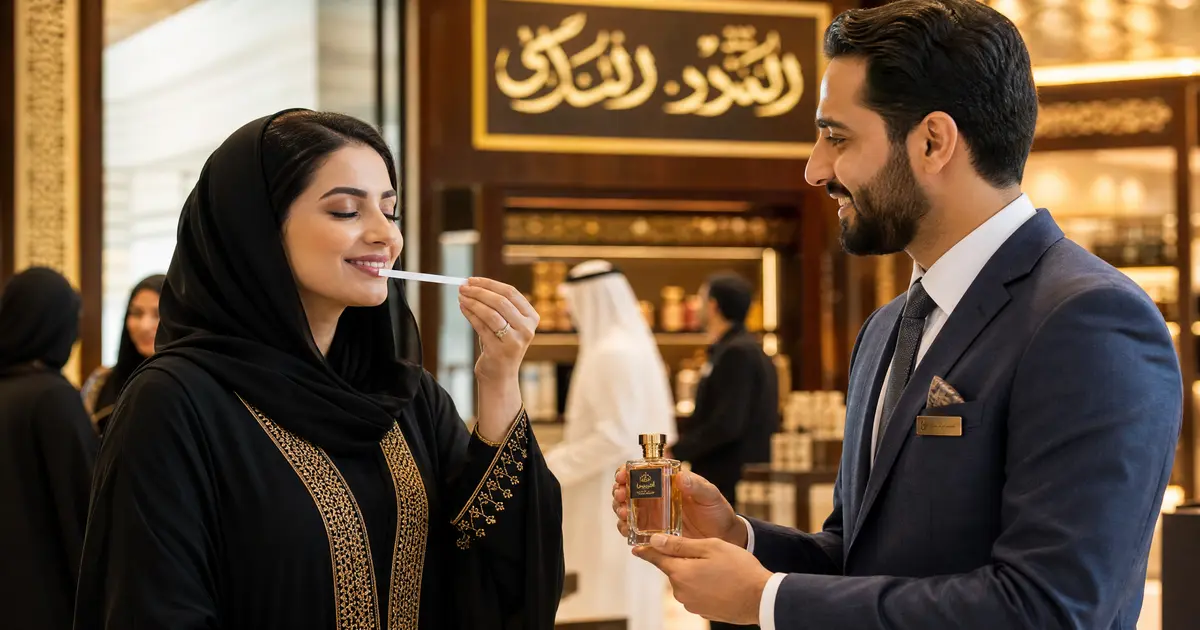
Beyond the Bottle: Powerful Sensory Marketing Examples Redefining UAE Brand Experiences
We live in a world saturated with visual noise. The average consumer scrolls past hundreds of images and videos daily, yet rarely do these digital encounters leave a lasting imprint. Smell, however, works differently. The olfactory system connects directly to the brain’s limbic system the seat of memory and emotion. This isn't merely poetic metaphor; it is biology. For brands in the UAE, a region with a deep cultural reverence for fragrance, the strategic deployment of scent has become the ultimate differentiator. This article explores concrete sensory marketing examples, demonstrating how businesses from retail to culture are engineering unforgettable human experiences that static logos and jingles can no longer achieve.
The Science of the Invisible Influence
Why does the scent of fresh oud or roasted Arabic coffee instantly evoke a sense of home and hospitality? Unlike sight or sound, scent bypasses the analytical thalamus and arrives directly at the hippocampus and amygdala . The implications for marketers are profound. You are not just creating a pleasant atmosphere; you are encoding a brand directly into the emotional memory bank. In the UAE perfume market, currently valued at approximately USD 750 million and driven by an ingrained cultural affinity for luxury fragrances, consumers possess a highly sophisticated olfactory palate .
This isn't merely about making a space smell "nice." It is about triggering a visceral, pre-cognitive response. A consumer is 100 times more likely to remember a scent than something they see, hear, or touch . When a brand in Dubai or Abu Dhabi taps into this, they are no longer competing for attention; they are securing a place in the subconscious. The best sensory marketing examples are those where the scent feels less like a marketing tactic and more like an authentic atmospheric truth.
The Cultural Blueprint: Why the UAE is Fertile Ground
Global statistics tell us that 73% of consumers believe brands should engage all their senses, and 70% of Gen Z feel their scent reflects their identity . In the Emirates, these numbers resonate even deeper. Perfume is not an accessory here; it is a signifier of identity, cleanliness, and hospitality. The UAE perfume market is projected to grow as increasing disposable income and demand for luxury goods solidify the region's status as a global fragrance hub . This makes the UAE uniquely receptive to olfactory branding, but also uniquely demanding. The local audience can distinguish synthetic cheapness from authentic depth in seconds.
Any global brand entering this market must understand that "sensory marketing" cannot mean spraying a generic vanilla fog. It means engaging with the notes deeply etched in local heritage: smoky oud, rich amber, damask rose, spicy saffron, and fresh jasmine . When a luxury hotel or a retail space diffuses a fragrance aligned with these native olfactive pillars, it communicates respect and place-attachment.
Concrete Sensory Marketing Examples: UAE Case Studies
To move beyond theory, let's examine specific case studies where scent integration moved the needle on business metrics and cultural resonance.
1. The Data-Driven Retail Revolution: Precision Targeting
One of the most compelling recent examples comes not from a perfume house, but from a toothpaste brand utilizing AI-powered sensorics in Carrefour stores across the UAE. While the product wasn't olfactory, the methodology is a blueprint for scent marketing. Using real-time audience intelligence, the campaign achieved a 68% sales uplift in just 20 days by triggering specific content based on real-time demographics . Imagine applying this to scent: a sensor detecting a specific footfall demographic triggers a targeted fragrance diffusion in a mall alcove. It underscores that modern sensory marketing is not passive ambiance, but an active, measurable conversion tool.
2. Museum Curation: The Scent of Heritage
Zayed National Museum in Abu Dhabi represents a pioneering benchmark. Collaborating with Emirati fragrance house, the museum engineered a signature scent that pays tribute to Sheikh Zayed’s bond with the land . It blends oud, jasmine, and native flora to create an "invisible thread" connecting visitors to the UAE's identity. This is experience design at its highest level. The ambient soundscapes of deserts and seas, combined with this bespoke scent, ensure that the historical narrative is not just seen, but felt. It transforms the act of learning into an act of immersion .
3. Cultural Congruence in Hospitality
The academic research on olfactory marketing in hospitality reveals a critical nuance relevant to the UAE’s booming hotel sector: scent must be "place-congruent" . When a hotel lobby diffuses a scent that aligns with its architectural identity and cultural location, it enhances authenticity and triggers "affective modulation" an improvement in mood that directly correlates with loyalty and positive word-of-mouth . However, the research warns that perceived synthetic or manipulative scents backfire, eroding trust. For a Dubai beach resort, this might mean a light marine accord. For a desert oasis property, it means grounding the air in woody, sandalwood notes. It is the art of crafting an invisible sense of place.
A Regional Playbook: From Tradition to AI
The trajectory of sensory marketing examples in the UAE is moving from simple ambient scenting to a complex, personalized science. This evolution can be visualized through three-tiered evolution of sensory marketing in the UAE.
Step 1: Cultural Foundation: This is the non-negotiable base. Brands must root their scent identity in the cultural DNA of the region oud, rose, and amber fragrances that command a market value of $750 million .
Step 2: Experience Economy: Moving beyond products, institutions like Zayed National Museum are leveraging scent to forge emotional connections to heritage, while hotels use "place-congruent" scents to authentically enhance guest experiences .
Step 3: Tech & Measurement: The future lies in data. The AI sensorics case in UAE retail proved that targeting the right audience in real-time can create a 68% sales uplift, representing a significant leap in the precision of sensory marketing .
Practical Craft: Signature Scents vs. Product Sales
For a brand exploring this space, distinguishing between "ambient scent branding" and "product marketing" is vital. Ambient scenting aims for emotional anchoring over time; it doesn't ask for an immediate sale. It builds mental availability. Product marketing, as seen by Ajmal Perfumes' expansion into travel retail, focuses on the bottle. Ajmal’s strategy of blending "modern Arabic" notes in exclusives for duty-free locations targets the immediate desire for tangible luxury .
However, the lines blur beautifully. When a hotel sells a room diffuser of its lobby scent, the ambient experience becomes a transaction. The sensory marketing example here aligns with the behavioral trend uncovered in the Irish hospitality study: consumers who form positive episodic memories through scent are likely to purchase the scent-associated product for home use to re-live the experience . It closes the circle from emotion to commerce.
Navigating Missteps: The Authenticity Mandate
A critical reality check exists for sensory marketing in the UAE. The market intelligence reveals a crowded battlefield with over 300 brands, where regulatory compliance with Gulf Standards Organization guidelines is strict . The greatest danger, however, is inauthenticity. If a brand with Western origins attempts to mimic "Oriental" scent profiles without genuine ingredient integrity, the Emirati consumer will detect the superficiality. The research is clear: synthetic or excessive scents in hospitality lead to emotional disengagement and brand avoidance .
Transparency is a non-negotiable. A brand should be as proud of its diffuser oil ingredients as a perfume house is of its raw materials. The "black box" of scent should, paradoxically, be demystified to build trust. If you incorporate sustainable, eco-friendly sourcing a market segment projected to reach USD 500 million in the UAE you align with the values of the emerging generation .
Actionable Checklist for UAE Scent Marketers
For a marketing director looking to implement a sensory strategy, the following steps ensure alignment with regional specifics and best practices:
Audit the Cultural Fit: Does your scent concept integrate regional olfactive profiles (oud for authenticity, saffron for warmth, rose for hospitality), or is it a generic global preset?
Define the KPI: Precisely define whether you are measuring dwell time, emotional engagement, or direct sales uplift. Apply a data-driven methodology to programmatic scent delivery where possible .
Prioritize Place-Congruence: Ensure the scent matches the physical and cultural geography. A marine scent feels alien in a desert-facing lobby; a heavy oriental might overwhelm a minimalist modern clinic.
Commit to Transparency: Proactively disclose your scent branding methodology in your sustainability or "About Us" narrative. If the ingredients are natural and sustainably sourced, lead with that story.
Conclusion: Creating the Invisible Thread
The evolution of digital marketing has paradoxically led us back to the primordial power of the nose. In the United Arab Emirates, where the language of scent is spoken fluently from adolescence, sensory marketing is not a gimmick; it is a return to the local vernacular. The sensory marketing examples emerging from the region from AI-powered retail precision in Carrefour to the heritage-soaked halls of Zayed National Museum demonstrate that the goal is no longer just to be seen . The goal is to be remembered.
The invisible thread of scent weaves through memory, triggering loyalty that visual stimuli alone cannot achieve. For the brand that harnesses this with authenticity, data intelligence, and a deep bow to cultural reverence, the reward is a lasting place in the heart of the nation.