
- Diffuser Combo UAE Deals
- Scents
- Floral (Rose, Jasmine)
- ADDRESS Aroma Oil Diffuser 500ML
- PASSION Aroma Oil Diffuser 500ML
- HARMONY Aroma Oil Diffuser 500ML
- LUXURY Aroma Oil Diffuser 500ML
- MOTION Aroma Oil Diffuser 500ML
- SOSPHERA Aroma Oil Diffuser 500ML
- SENSE Aroma Oil Diffuser 500ML
- G BLOOM Aroma Oil Diffuser 500ML
- LEGENDARY Aroma Oil Diffuser 500ML
- FOR HER Aroma Oil Diffuser 500ML
- No 3 Aroma Oil Diffuser 500ML
- PINK Aroma Oil Diffuser 500ML
- Fresh (Citrus, Aquatic)
- Woody / Oriental / Spicy (Oud, Vanilla, Amber, Sandalwood)
- ROYAL WOOD Aroma Oil Diffuser 500ML
- BROWN ORCHID Aroma Oil Diffuser 500ML
- BAKHOUR Aroma Oil Diffuser 500ML
- AMBER LEATHER Aroma Oil Diffuser 500ML
- UNIQUE WOOD Aroma Oil Diffuser 500ML
- ELITE WOOD Aroma Oil Diffuser 500ML
- MARRAKECH Aroma Oil Diffuser 500ML
- Patchouli Aroma Oil Diffuser 500ML
- COTTON CLOUD Aroma Oil Diffuser 500ML
- CHRISTMAS Aroma Oil Diffuser 500ML
- GABRIEL Aroma Oil Diffuser 500ML
- CINNAMON TONKA Aroma Oil Diffuser 500ML
- COFFEE BEANS Aroma Oil Diffuser 500ML
- Aromatic (Fougere) – Lavender, Sage, Rosemary
- Fruity (Berry, Peach)
- Floral (Rose, Jasmine)
Scent Blog
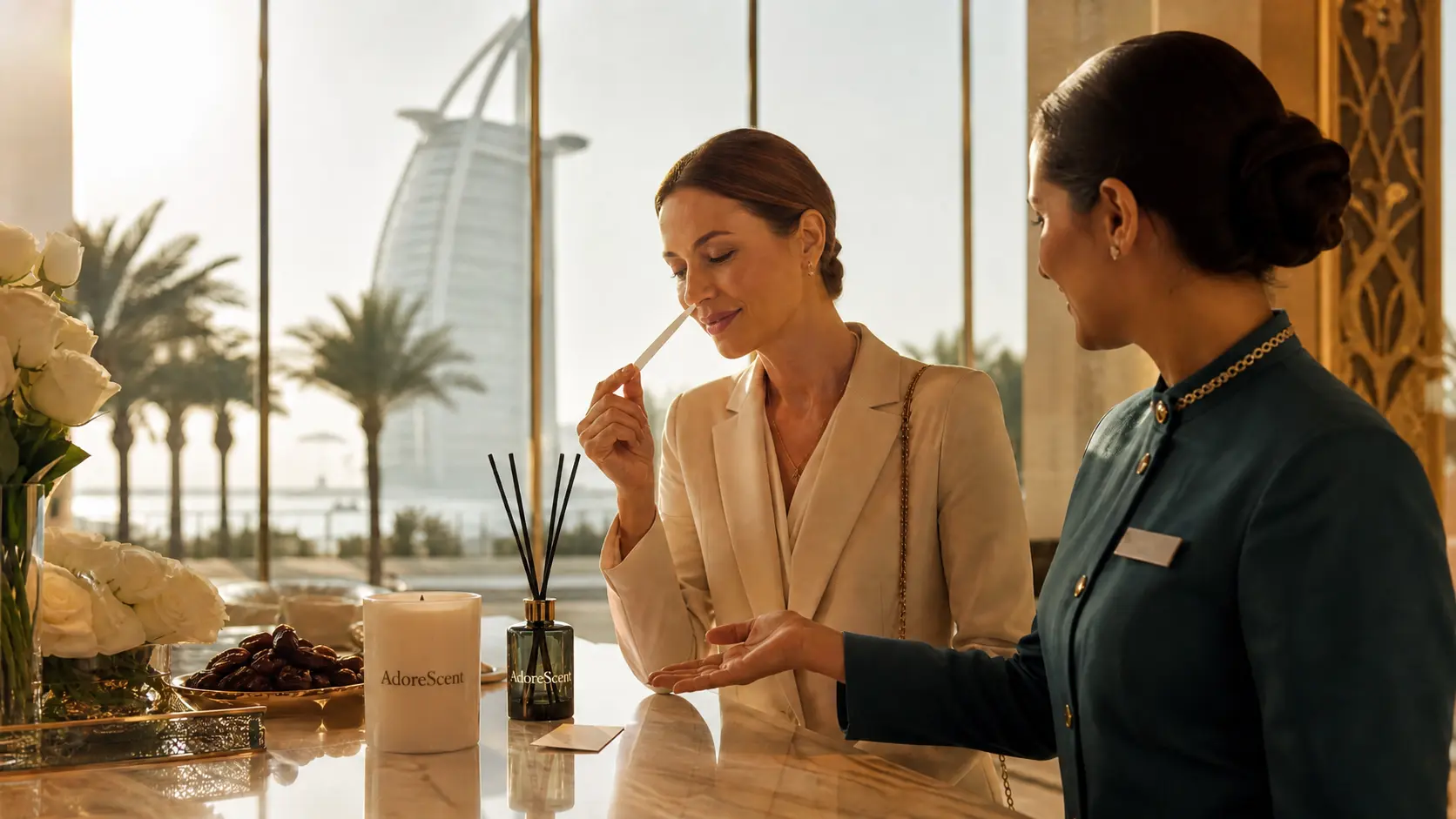
Why UAE Luxury Hotels Are Investing in Olfactory Branding?
You might assume visual opulence defines a five-star stay in the Emirates, the shimmering Burj Khalifa views, the imported Italian marble, the lavish lobby floral arrangements. Yet step into any leading luxury hotel in Dubai or Ras Al Khaimah right now, and you will notice something has shifted. The competition for guest loyalty is no longer just a visual battle; it has become an invisible one. UAE luxury hotels are increasingly turning to signature scents not as an afterthought, but as a strategic pillar of their brand identity.
This is not about masking odors. It is about engineering emotion. As the UAE’s hospitality landscape grows ever more saturated, hoteliers are recognizing what neuroscientists have long known: the olfactory system is the only sense directly wired to the brain’s limbic system, the seat of memory and emotion. In a market where every hotel boasts world-class architecture, the true differentiator has become the feeling a guest carries home, often triggered by a scent they cannot forget .
The Scent of an Icon: The Lana and the Power of "Quiet Luxury"
To understand the current wave of investment, look no further than the Dorchester Collection’s first Middle Eastern venture, The Lana, located in the Marasi Bay Marina. This property epitomizes the "quiet luxury" trend currently dominating the UAE market. The Lana didn't just select a generic floral bouquet; they Engineered a distinct "olfactory logo" .
The brief was highly specific: to create a scent that embodies the weightlessness of the waterfront property while standing in stark contrast to the heavier, oud-centric fragrances common in the region. The result was a citrus floral profile blending bergamot, jasmine, and sea salt .
What makes this a case study for the blog is the intentionality behind this choice. The scent diffused throughout the public spaces and the Dior Spa isn't just a fragrance; it is a sophisticated psychological anchor. It addresses a nuanced market-specific challenge: how to convey opulence without overwhelming the senses in a city already saturated with stimulation. By crafting a scent that feels like a soothing whisper rather than a shout, The Lana ensures that its emotional signature connects deeply with guests seeking refuge from urban chaos. This proves that olfactory branding in UAE luxury hotels is not about smell alone; it is about crafting a palpable feel of magnificence that reinforces the architectural story .
Beyond the City: Rooting Scent in the Desert Landscape
While city hotels like The Lana use scent to conjure clean sophistication, UAE desert resorts are tapping into something far more primal: a connection to the land itself. This approach addresses a critical signal cultural authenticity.
The most compelling recent evidence of this investment is the partnership between The Ritz-Carlton Ras Al Khaimah, Al Wadi Desert, and a Emirati perfume house. This collaboration is not your standard branded lobby diffuser. It represents a rigorous integration of local craftsmanship into the luxury travel experience.
The Perfume House helped the resort frame fragrance as a lived cultural narrative. Guests don’t just walk past a pleasant smell; they enter a "Desert Perfume Atelier" where they engage with raw materials like Emirati rose, moringa, sidr, and oud . This matters because modern luxury travelers especially those seeking out high-value UAE experiences crave authenticity over artifice. For a fee starting at AED 950, guests receive a guided consultation, handling the raw resins and oils that have defined Arabian identity for centuries.
The demand for this level of personalized sensory luxury is surging. The resort even offers a "Private Royal Blend" experience, costing AED 4,500, where a master perfumer archives a guest's formula for international reorders . This transforms a transient smell into a long-term asset. For the hotel, the investment pays off in guest retention and word-of-mouth marketing long after the UAE summer fades.
The Neuroscience Driving the Balance Sheet
Why are these luxury hotels channelling significant capital into custom diffusers, scent architects, and perfumery experiences? The answer lies in the tangible return on investment (ROI) that olfactory branding brings, backed by data that enhances editorial authority.
The connection between scent and recall is so powerful that it has become a critical metric for hotel marketers. Luxury brands are not just selling sleep; they are selling memorability . When a hotel like The Lana diffuses its signature bergamot and sea salt blend, it is planting a retrieval cue in the guest's brain. Months later, encountering a similar note will trigger a flood of vacation memories a cognitive bias that drives rebooking.
Furthermore, olfactory branding in the UAE solves a unique market problem: the "scent clash." Many high-end properties use heavy ambient fragrances that can clash with a guest’s personal perfume or the arid desert air. The investment in "quiet" or "smart" scenting fragrances that enhance the environment without dominating it, demonstrates a high level of hospitality expertise . By ensuring the signature scent complements rather than competes, hotels signal that they understand the hyper-sensory awareness of their clientele.
Cultural Sensitivity and the Emirati Identity
For a blog like AdoreScent, it is vital to underscore that scent branding in the UAE is not a trend imported from Western chain hotels. It is a deep-rooted cultural practice. In Emirati heritage, fragrance is an expression of personality, presence, and hospitality. Notes that locals carry oils everywhere, viewing fragrance as an essential part of daily life rather than a luxury accessory .
By investing in olfactory branding, UAE luxury hotels are effectively bridging the gap between global luxury standards and local identity. This offers a significant lesson for your readers: a scent strategy disconnected from regional culture will fail. The success of the Ritz-Carlton’s collaboration lies in its educational component. It appeals to international tourists seeking an "authentic" Arabian experience while honoring the craftsmanship locals grew up with .
This is the kind of insight that builds topical authority for your site. When you discuss these partnerships, you are not just describing a product release; you are analyzing a cultural exchange where the hotel becomes the storyteller. The scent is the medium.
Actionable Strategies for Industry Professionals
Here’s how the UAE market is refining its approach:
The Signature "Logo" vs. The Experience: Standard hotel chains often blast the same scent globally. The new UAE model uses scent as an experience. The Lana’s scent is designed for its specific architectural "weightlessness" . The Ritz-Carlton’s scent is a journey. The investment lies in customization.
Monetizing the Scent: UAE luxury hotels are no longer just burning the scent in the lobby; they are selling it. The "Private Royal Blend" experience is a masterclass in monetizing sensory memory . By allowing guests to reorder their signature blend, the hotel maintains a lifelong revenue stream and emotional connection.
Low-Intensity, High-Impact Diffusion: Technology is invisible. Hotels are investing heavily in HVAC-integrated systems where the power is hidden but the result is pervasive, ensuring the scent feels mysterious rather than manufactured .
The Future Is Invisible
The investment trajectory suggests that a luxury hotel in the UAE without a scent strategy will soon be as obsolete as a luxury hotel without Wi-Fi. The conversation has moved from "Should we have a signature scent?" to "What story does our scent tell about the land, the culture, and the emotional state we want guests to inhabit?"
For AdoreScent, providing this data-backed, culturally aware analysis is the cornerstone of building authority. The brands winning in this space are those treating air not just as empty space to be filled, but as the most intimate canvas for their brand story. By documenting this evolution citing partnerships, analyzing market-specific case studies, and understanding the neuroscience your blog can become the definitive voice on Middle Eastern olfactory art. In the UAE's luxury hospitality scene, what you breathe is what you remember. And what you remember, you ultimately buy.