
- Diffuser Combo UAE Deals
- Scents
- Floral (Rose, Jasmine)
- ADDRESS Aroma Oil Diffuser 500ML
- PASSION Aroma Oil Diffuser 500ML
- HARMONY Aroma Oil Diffuser 500ML
- LUXURY Aroma Oil Diffuser 500ML
- MOTION Aroma Oil Diffuser 500ML
- SOSPHERA Aroma Oil Diffuser 500ML
- SENSE Aroma Oil Diffuser 500ML
- G BLOOM Aroma Oil Diffuser 500ML
- LEGENDARY Aroma Oil Diffuser 500ML
- FOR HER Aroma Oil Diffuser 500ML
- No 3 Aroma Oil Diffuser 500ML
- PINK Aroma Oil Diffuser 500ML
- Fresh (Citrus, Aquatic)
- Woody / Oriental / Spicy (Oud, Vanilla, Amber, Sandalwood)
- ROYAL WOOD Aroma Oil Diffuser 500ML
- BROWN ORCHID Aroma Oil Diffuser 500ML
- BAKHOUR Aroma Oil Diffuser 500ML
- AMBER LEATHER Aroma Oil Diffuser 500ML
- UNIQUE WOOD Aroma Oil Diffuser 500ML
- ELITE WOOD Aroma Oil Diffuser 500ML
- MARRAKECH Aroma Oil Diffuser 500ML
- Patchouli Aroma Oil Diffuser 500ML
- COTTON CLOUD Aroma Oil Diffuser 500ML
- CHRISTMAS Aroma Oil Diffuser 500ML
- GABRIEL Aroma Oil Diffuser 500ML
- CINNAMON TONKA Aroma Oil Diffuser 500ML
- COFFEE BEANS Aroma Oil Diffuser 500ML
- Aromatic (Fougere) – Lavender, Sage, Rosemary
- Fruity (Berry, Peach)
- Floral (Rose, Jasmine)
Scent Blog
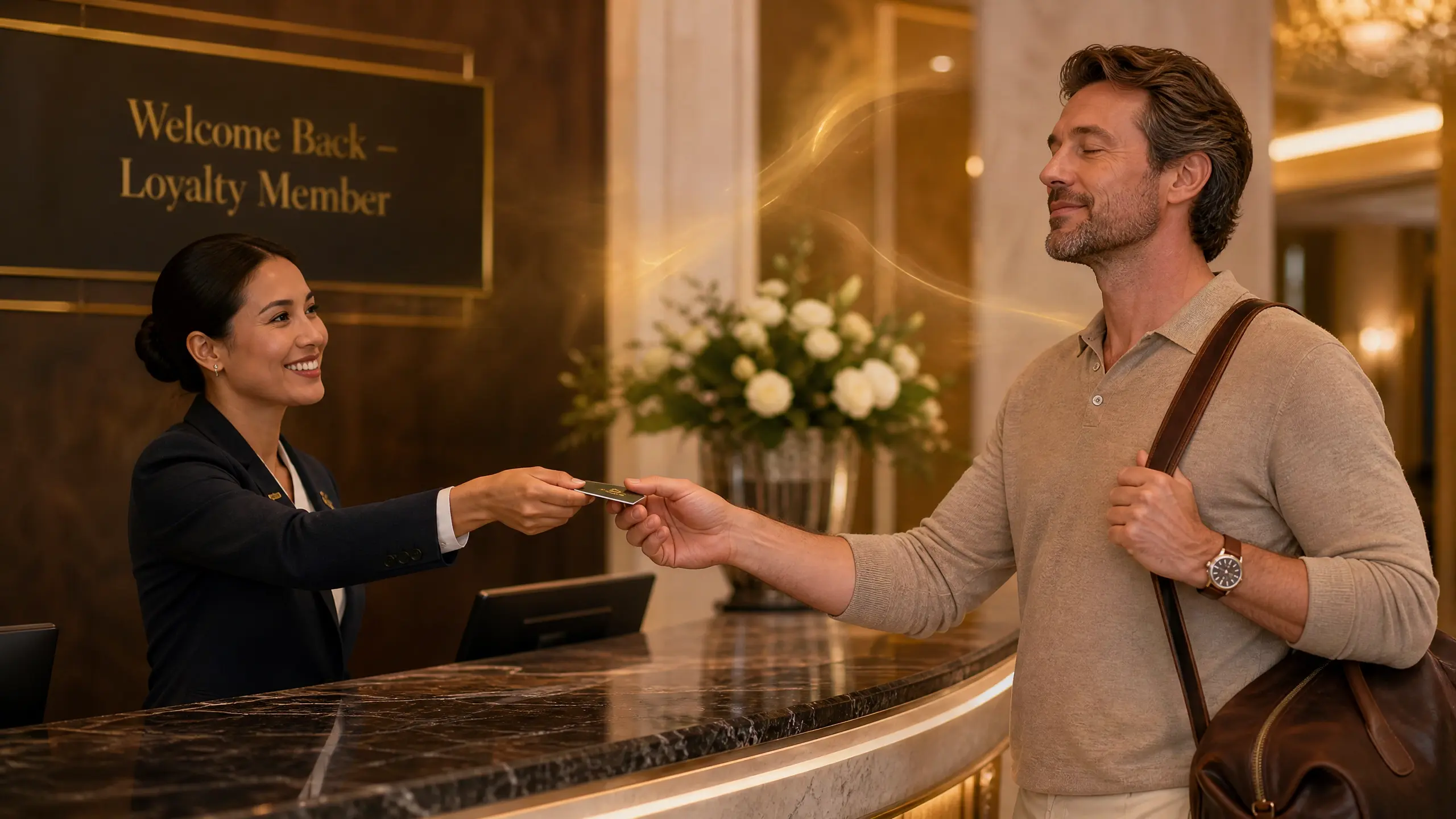
The Invisible Welcome: How Signature Scenting Increases Hotel Guest Retention
By the AdoreScent Editorial Team
In the fiercely competitive landscape of Emirati hospitality, marble lobbies and gold-leaf cappuccinos no longer guarantee a second visit. In a city like Dubai, where 713 hotels vie for the attention of the discerning traveler, the battle for loyalty isn’t won by what guests see, it’s won by what they feel the moment the sliding doors hush closed behind them.
We aren’t talking about temperature or texture. We are talking about the olfactory narrative the subtle, invisible architecture of air. For hoteliers looking to secure long-term profitability, the conversation has shifted from mere customer acquisition to the holy grail of the industry: Hotel Guest Retention.
Anchoring Memory in the Limbic Lobby
Why does a specific scent transport you back to a summer vacation from two decades ago, while a photograph of the same trip stays forgotten in a cloud storage folder?
The science is stark. The olfactory bulb is directly tethered to the amygdala and hippocampus, the emotional and memory headquarters of the human brain. Visual, auditory, and tactile data must pass through the thalamus (the brain’s switchboard) before reaching these deep centers. Scent doesn’t wait in line. It hits the limbic system instantly, unfiltered.
For a hotelier in Abu Dhabi or Ras Al Khaimah, this isn't neuroscience trivia; it’s the blueprint for sticky loyalty. When you diffuse a bespoke signature scent in a lobby, you aren’t just masking the 45-degree Celsius heat outside. You are chemically forging a visceral memory. A guest may forget the thread count of the bedsheets, but three months later, in a boardroom in London, catching a whisper of bergamot and white oud will ignite an irrational, powerful longing to return to your property.
Why the "DIFC Effect" Matters for Retention
Dubai has a distinct olfactory identity challenge. The air often carries the aroma of luxury itself high-end leather from designer boutiques, the smoky sweetness of shisha terraces, and the sterile opulence of air conditioning coolant. To stand out, hotel scenting must be hyper-personalized. We call this the "DIFC Effect" named after the financial hub where aesthetic minimalism must balance with extreme sensory luxury to keep the global elite returning weekly.
A generic "white tea and lily" scent diffused in Singapore won't cut it in the UAE market. The Middle Eastern nose is culturally attuned to complexity. Notes of Oud, Dahn Al Oud, Saffron, and Taif Rose aren't just pleasantries here; they indicate status, warmth, and hospitality. When a hotel weaves these notes into a signature scent, it signals to the GCC traveler: This is a home away from home, not a sterile franchise.
This is the first pillar of retention: Cultural Congruence. A guest retains a hotel experience when the environment validates their identity.
From Soft Branding to Hard Data: The Retention Metrics
Skeptical F&B directors and resident managers often ask, "Does scent actually shift the needle on the balance sheet?" The proof isn't just anecdotal; it’s statistical. In a controlled study cited by hospitality consultants, effectively scented environments saw an increase in overall guest satisfaction scores by up to 10-15%.
But satisfaction doesn't always equal retention. Retention implies returning to your property despite the brand-new hotel opening next door offering a 30% opening discount.
Consider the operational friction points that destroy guest loyalty:
Perceived cleanliness failures.
Sterile, "hospital-like" corridors.
A lack of spatial distinction between the business center and the pool deck.
A sophisticated aroma-diffusion strategy solves all three. A crisp marine accord in the corridor signals microscopic cleanliness faster than a housekeeping cart stationed for hours. A warm, woody amber diffusion in the lobby lowers the observable heart rate of jet-lagged guests, reducing cortisol-driven complaints. When the business center smells distinct from the spa, the guest perceives the hotel as a "campus of experiences" rather than a box of rooms. This perceived value scaling is the psychological driver of return bookings.
The "Scented Check-Out" and Post-Stay Retention Strategy
The most common strategic error UAE hoteliers make is limiting scenting to the living room (the lobby). True retention relies on the "Scented Check-Out."
Most hotels fail guests at the final touchpoint: the folio delivery and the taxi queue. The last olfactory memory a guest has is often diesel fumes from the valet or the faint bleach wafting from the public restrooms.
Reframing this final chapter is where signature scenting becomes a commercial weapon. By diffusing a "departure blend" lighter, nostalgic, and proprietary near valet stands and entrance pillars, you engineer a "farewell note" that lingers in olfactory memory long after the Emirates boarding pass is scanned.
Furthermore, forward-thinking brands are now engineering "Scent-to-Shelf" strategies. This isn't just about spraying the lobby. It's about creating a line of miniature room diffusers, reed sticks, or linen mists sold via the minibar. When a guest spends 900 AED to ship a branded Oud & Citrus diffuser to their penthouse in Moscow, your retention rate ceases to be a gamble. You have physically inserted your hotel’s limbic signature into their daily life, triggering a bi-annual pilgrimage back to the source.
Navigating the Emirati Airspace: A Legal and Cultural Note
A word of caution specific to our regional market: it is critical in the UAE to partner with creators who understand International Fragrance Association (IFRA) compliance and volatile organic compound (VOC) regulations. The harsh climate means HVAC systems work overtime. Cold-air diffusion via dry-air nebulization is non-negotiable here. Heating, Ventilation, and Air Conditioning (HVAC) scenting using oil-based heat methods can clog coils and collect dust in desert environments, leading to maintenance nightmares that disrupt the guest experience.
The scent must be present but invisible. You want the guest to say, "The air feels peaceful here," not, "What perfume are they pumping in?" Mastery of this subtlety separates the independent boutique hotelier from the soulless mega-resort.
Case in Point: The Desert Resort Paradox
Let’s transport ourselves to a fictional yet entirely plausible luxury retreat in the Rub' al Khali. The property struggles deeply with retention. Guests tick the "desert experience" off their bucket list once and never return. Why? The memory is too distinct, too "one-off."
By introducing a "Rain in the Dunes" signature scent petrichor, green cypress, and a heart of Damask rose (a scent profile that feels miraculous in an arid climate) the resort changes its narrative. It’s no longer a dusty trek; it’s an oasis miracle. Guests begin to return not for the camel rides, but for the inexplicable feeling of breathing "wet earth" while overlooking the Empty Quarter. The scent creates a physiological relief that the architectural design of the tent alone could never achieve. The retention metric shifts, driven by a sensory craving that no competitor on the strip could copy simply by observing an Instagram post.
Designing Your Retention Alchemy
AdoreScent’s approach to guest retention never starts with the fragrance oil. It starts with an audit of the guest journey friction points.
The Efficiency-Emotion Matrix: We map zones where guests feel rushed (check-in desks, business lounges) versus zones where they seek indulgence (spas, beachfront cabanas). Speedy, crisp scents (Ginger, Citrus, Mint) drive efficiency in business zones. Languid, narcotic florals (Jasmine, Tuberose, Saffron) drive emotional depth in leisure zones.
The Night-to-Morning Axis: One scent does not fit a 24-hour day. A nighttime corridor fragrance should quiet the mind, promoting deep sleep (the single biggest driver of positive online reviews). Daytime scents should energize.
The Brand Echo: If your hotel’s brand promise is "Effortless Luxury," but your scent is heavy, sticky patchouli, you are creating sensory dissonance. Guests won’t return because the brain registers a lie.
Conclusion: The Retention Covenant
In the UAE, hospitality isn't just a transaction; it's a covenant of care. Guests return to hotels where they feel profoundly known and understood. In an era dominated by algorithmic recommendations and digital noise, the quiet, chemical truth of scent remains the most honest way to whisper to a guest’s soul: Stay. Return. You belong here.
As the market braces for even more inventory entering the landscape, the hotels that will survive are those that move beyond generic air fresheners. They are the ones who treat air not as empty volume, but as a canvas for memory. When a returning guest walks through your doors, closes their eyes, takes a breath, and smiles without knowing why you haven’t just retained a customer. You’ve secured a lifelong advocate.
That is the invisible power of signature scenting.