
- Diffuser Combo UAE Deals
- Scents
- Floral (Rose, Jasmine)
- ADDRESS Aroma Oil Diffuser 500ML
- PASSION Aroma Oil Diffuser 500ML
- HARMONY Aroma Oil Diffuser 500ML
- LUXURY Aroma Oil Diffuser 500ML
- MOTION Aroma Oil Diffuser 500ML
- SOSPHERA Aroma Oil Diffuser 500ML
- SENSE Aroma Oil Diffuser 500ML
- G BLOOM Aroma Oil Diffuser 500ML
- LEGENDARY Aroma Oil Diffuser 500ML
- FOR HER Aroma Oil Diffuser 500ML
- No 3 Aroma Oil Diffuser 500ML
- PINK Aroma Oil Diffuser 500ML
- Fresh (Citrus, Aquatic)
- Woody / Oriental / Spicy (Oud, Vanilla, Amber, Sandalwood)
- ROYAL WOOD Aroma Oil Diffuser 500ML
- BROWN ORCHID Aroma Oil Diffuser 500ML
- BAKHOUR Aroma Oil Diffuser 500ML
- AMBER LEATHER Aroma Oil Diffuser 500ML
- UNIQUE WOOD Aroma Oil Diffuser 500ML
- ELITE WOOD Aroma Oil Diffuser 500ML
- MARRAKECH Aroma Oil Diffuser 500ML
- Patchouli Aroma Oil Diffuser 500ML
- COTTON CLOUD Aroma Oil Diffuser 500ML
- CHRISTMAS Aroma Oil Diffuser 500ML
- GABRIEL Aroma Oil Diffuser 500ML
- CINNAMON TONKA Aroma Oil Diffuser 500ML
- COFFEE BEANS Aroma Oil Diffuser 500ML
- Aromatic (Fougere) – Lavender, Sage, Rosemary
- Fruity (Berry, Peach)
- Floral (Rose, Jasmine)
Scent Blog
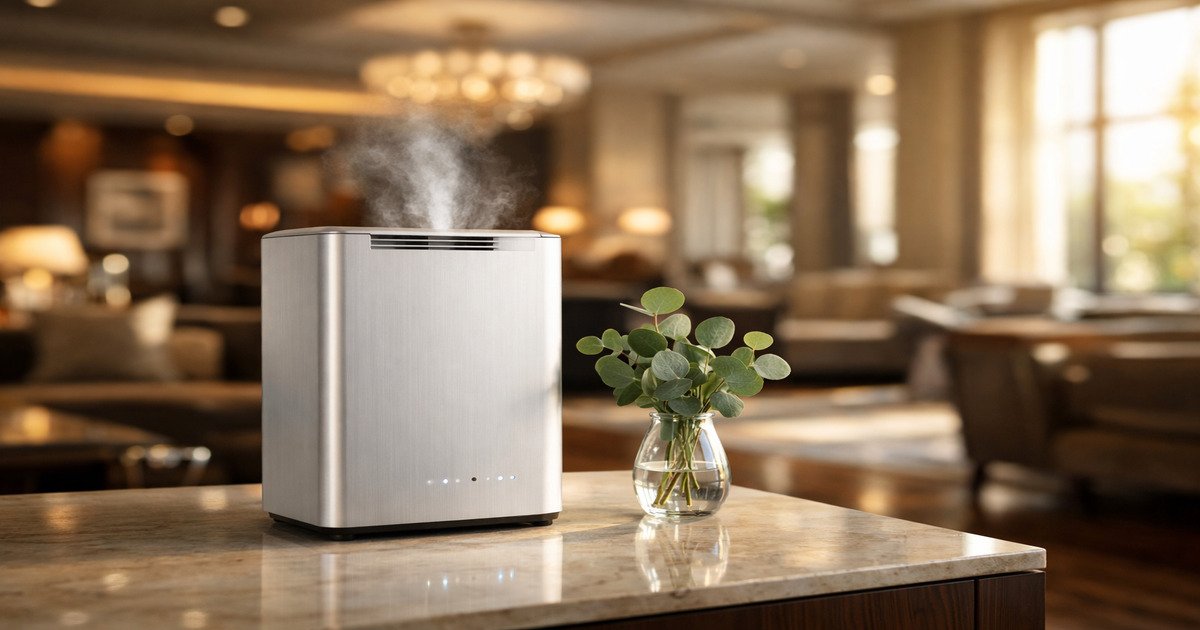
Beyond the Candle: How a Commercial Air Scenting Machine Transforms Ambience, Behavior, and Bottom Lines
Walk into any high-end hotel lobby or a bustling medical office today, and you will notice something unusual. It is not the furniture, the lighting, or the receptionist’s smile. It is the air itself. A subtle, clean, yet unmistakable signature lingers just at the edge of consciousness. This invisible layer of experience is rarely an accident. More often than not, it is the work of a commercial grade air scenting machine, a device that has quietly moved from a luxury novelty to a mainstream business tool.
For years, business owners relied on passive methods to manage indoor smell. Plug in air fresheners, reed diffusers, and aerosol sprays offered a temporary fix, but they failed to deliver consistency. A single spray covers one corner of a room for ten minutes. An air scenting machine, by contrast, operates on a principle of controlled diffusion. It takes a concentrated fragrance oil, breaks it into microscopic particles, and releases them into an HVAC system or directly into a room at precise intervals. The result is a uniform, persistent atmosphere that does not overwhelm but simply exists as part of the architecture.
The shift toward automated scenting is not a fad. A study published, researchers found that a subtle, congruent ambient scent increased customer dwell time by nearly forty percent in a home furnishings store. The study, led by Dr. Eric Spangenberg, noted that “olfactory cues processed outside conscious awareness still exert a powerful influence on perceived merchandise quality.” This is the quiet power of a well placed air scenting machine. It does not announce itself. It simply works beneath the threshold of active thought, nudging mood and perception without a single spoken word.
From a practical standpoint, the decision to install an air scenting machine often comes down to three real world problems: inconsistency, waste, and liability. Traditional aerosol systems rely on human memory. An employee has to remember to press a button every fifteen minutes, or the scent fades. Diffusers with sticks dry out and lose strength. An air scenting machine eliminates the human variable. Most modern units connect to digital timers or mobile applications. You set the on time, the off time, and the intensity. Then you walk away. The machine does the rest, day after day, without fatigue or forgetfulness.
Consider the waste factor. A typical consumer aerosol can contains propellants and solvents that do nothing for fragrance. You are paying for the pressure, not the perfume. A professional air scenting machine uses cold air or ultrasonic vibration to atomize pure oil. There is no heat to degrade the molecular structure and no chemical propellant to dilute the strength. Every drop becomes airborne and active. Over a month of continuous use, the operational cost of an air scenting machine often falls below the cost of buying disposable fresheners from a big box store. The numbers favor the machine, but more importantly, the guest experience favors the machine.
Hospitality was the first industry to truly embrace this technology. Hoteliers learned early that the scent of a lobby directly influences a guest’s perception of cleanliness. A study from the examined three identical hotel lobbies. One had no scent, one had a generic floral spray, and one used a calibrated air scenting machine delivering a signature citrus and cotton blend. The study found that guests in the machine scented lobby rated the hotel’s cleanliness twenty three percent higher than the unscented group, even though the physical space was identical. The authors concluded that “ambient olfactory conditions serve as a non visual proxy for hygiene and order.” That is a powerful return on a relatively small investment.
But an air scenting machine is not only for luxury hotels. Gyms have discovered that a clean, aquatic scent reduces the perception of stale sweat. Car dealerships use a leather and suede fragrance to reinforce the idea of newness and luxury. Medical waiting rooms, notoriously stressful environments, have begun diffressing calming lavender and chamomile blends. In each case, the tool is the same. Only the oil changes. This versatility is why a single air scenting machine can serve a dentist’s office in the morning and a yoga studio in the afternoon, assuming the space is zoned correctly.
One of the most overlooked benefits is brand identity. Visual branding is limited to what a customer sees. Logos, colors, and typography are passive. Scent branding is active. It follows a customer through a space and lingers on their clothing for minutes after they leave. A retail store that uses a signature cedar and vanilla blend in its air scenting machine is creating a memory trigger. When that customer smells cedar elsewhere, the brain may unconsciously recall the store, the products, even the sales interaction. This is olfactory associative learning, a well documented phenomenon in cognitive psychology. A paper stated that “odor paired with a commercial environment can enhance brand recall by up to sixty five percent relative to visual cues alone.” That is not marketing hype. That is neurobiology.
Of course, not every air scenting machine is created equal. The market has three primary technologies. Nebulizing systems use pressurized air to blast oil through a nozzle, creating a very fine mist. These are powerful but can be noisy. Heat based systems warm the oil to encourage evaporation, but heat changes the character of complex fragrances. Ultrasonic systems use high frequency vibrations to create a cool fog. For most indoor commercial spaces, the ultrasonic air scenting machine offers the best balance of silence, safety, and scent fidelity. The oil never burns, so the top notes remain intact.
Installation is simpler than many business owners fear. A standalone air scenting machine sits on a shelf or counter, plugs into a standard outlet, and requires nothing more than an oil refill every few weeks. Larger spaces benefit from an HVAC mounted unit, which ties directly into the existing ductwork. This hidden approach keeps the hardware out of sight and distributes the scent evenly across multiple rooms. An HVAC integrated air scenting machine can cover ten thousand square feet without a single visible diffuser head. That is the gold standard for retail chains and office buildings.
Maintenance is minimal but necessary. The nozzles on an air scenting machine can become clogged if low quality oils are used. Thick, syrupy fragrances with added dyes or carrier oils leave residue. Professional grade fragrances are thin, clear, and designed specifically for cold air diffusion. Changing the oil bottle takes thirty seconds. Cleaning the nozzle with a drop of alcohol once a month keeps the machine running for years. Some operators skip this step, then blame the hardware when performance drops. But a well maintained air scenting machine will outlast the lease on the building itself.
There is also a growing conversation about health and sensitivity. A responsible installation of an air scenting machine includes thoughtful placement. No machine should diffuse directly into a breathing zone, such as above a desk or beside a receptionist’s face. The goal is ambient background, not direct exposure. Many modern units pulse the fragrance for five seconds then pause for thirty seconds. This intermittent cycle prevents olfactory fatigue, the phenomenon where a continuous scent becomes invisible to the nose. It also reduces total volatile organic compound load in the air. A study evaluated VOC emissions from a cold air air scenting machine versus an electric plug in warmer. The cold air unit produced ninety percent fewer VOCs per hour of operation. For businesses concerned about employee health or LEED certification, that difference is decisive.
The question for most business owners is not whether to try an air scenting machine, but where to start. The answer begins with a single zone. Pick the highest traffic area, the place where first impressions form. A hotel lobby, a retail entrance, a medical waiting room. Install a small ultrasonic unit and run a single, simple fragrance. Citrus for energy, lavender for calm, cedar for cleanliness. Run it for two weeks. Ask staff if they notice a difference. Ask regular customers, but do not tell them why. Their unprompted comments will tell you everything. If someone says “it feels nicer in here” without knowing about the machine, you have succeeded.
One common mistake is over scenting. A novice operator sets an air scenting machine to maximum intensity, believing more is better. In reality, the most effective scent level is the one that goes unnoticed as a discrete smell. You want the quality, not the quantity. The fragrance should be identifiable only when a customer actively tries to find it. This sub threshold intensity is where the psychological research shines. The brain registers the cue, associates it with cleanliness or luxury or calm, but never stops to question why. That is the art of it.
Costs have dropped significantly in the last five years. A basic consumer grade air scenting machine can be found for under one hundred dollars, though these are often unreliable for commercial use. A true commercial unit, built with a metal chassis and a silent fan, typically ranges from two hundred fifty to six hundred dollars. Oils run twenty to forty dollars for a liter, and a liter lasts a single unit roughly three months in a moderate duty cycle. Compare that to the cost of lost sales from an unpleasant odor, or the cost of a negative online review mentioning a strange smell. The air scenting machine becomes not an expense but an insurance policy.
Looking forward, the technology continues to evolve. Smart units now connect to building management systems. They can adjust output based on occupancy sensors, turning up during peak hours and down during slow periods. Some integrate with point of sale systems, releasing a burst of a different fragrance at the checkout counter to signal the end of the shopping journey. This level of nuance was impossible five years ago. Today, an air scenting machine can be as sophisticated as a thermostat or a lighting control panel.
The final piece of advice for any business considering this step is to think seasonally. A single fragrance year round becomes invisible. Change the oil every quarter. A bright green tea and ginger for spring, a clean ocean mist for summer, a warm sandalwood for autumn, a crisp pine for winter. This rotation keeps the olfactory system engaged and gives returning customers a subtle cue that time has passed. They will not say “you changed the scent.” They will say “it feels fresh in here.” That feeling is the whole point.
A well chosen, properly installed, and thoughtfully maintained air scenting machine does more than make a room smell nice. It shapes behavior, supports brand memory, reduces waste, and quietly reassures every person who walks through the door. In a world where businesses compete on experience, the air itself has become a competitive advantage. And the machine that manages that air is one of the most cost effective tools a business owner can buy.